
Cambridge 16 listening test 04
IELTS Listening Mock Test
Follow the instructions in the audio. After the final audio you will have 2 minutes to check your answers.
Part 1
Questions 1 – 10
Complete the notes below.
Write ONE WORD AND/OR A NUMBER for each answer.
Holiday rental
Owner’s names: Jack Fitzgerald and Shirley Fitzgerald
Granary Cottage
● available for week beginning 1. .. May
● cost for the week: 2. ..
3. .. Cottage
● cost for the week: £480
● building was originally a 4 ..
● walk through doors from living room into a 5. ..
● several 6. .. spaces at the front
● bathroom has a shower
● central heating and stove that burns 7. ..
● views of old 8. .. from living room
● view of hilltop 9. .. from the bedroom
Payment
● deposit: £144
● deadline for final payment: end of 10 ..
Granary Cottage
● available for week beginning 1. .. May
● cost for the week: 2. ..
3. .. Cottage
● cost for the week: £480
● building was originally a 4 ..
● walk through doors from living room into a 5. ..
● several 6. .. spaces at the front
● bathroom has a shower
● central heating and stove that burns 7. ..
● views of old 8. .. from living room
● view of hilltop 9. .. from the bedroom
Payment
● deposit: £144
● deadline for final payment: end of 10 ..
Part 2
Questions 11-14
Choose the correct letter, A, B or C.
Local council report on traffic and highways
11 A survey found people’s main concern about traffic in the area was
Choose the correct letter, A, B or C.
Local council report on traffic and highways
11 A survey found people’s main concern about traffic in the area was
12 Which change will shortly be made to the cycle path next to the river?
13 Plans for a pedestrian crossing have been postponed because
14 On Station Road, notices have been erected
Questions 15-20
Label the map below.
Write the correct letter, A-I, next to Questions 15-20.
Recreation ground after proposed changes
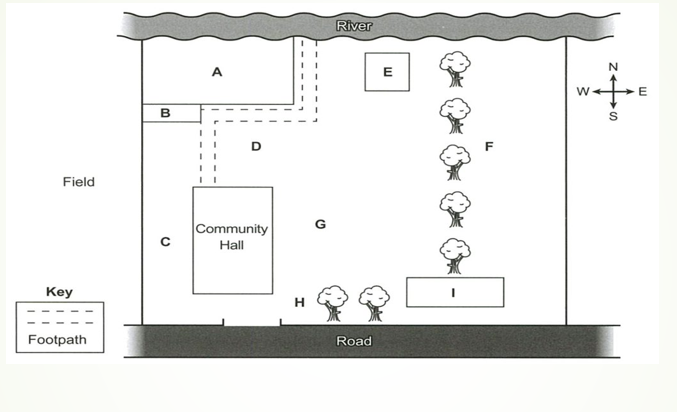
15 New car park
16 New cricket pitch
17 Children’s playground
18 Skateboard ramp
19 Pavilion
20 Notice board
Part 3
Questions 21-22
Choose TWO letters, A-E.
Which TWO benefits of city bike-sharing schemes do the students agree are the most important?
Choose TWO letters, A-E.
Which TWO benefits of city bike-sharing schemes do the students agree are the most important?
Questions 23-24
Choose TWO letters, A-E.
Which TWO things do the students think are necessary for successful bike-sharing schemes?
Choose TWO letters, A-E.
Which TWO things do the students think are necessary for successful bike-sharing schemes?
Questions 25-30
What is the speakers’ opinion of the bike-sharing schemes in each of the following cities?
Choose SIX answers from the box and write the correct letter, A-G, next to Questions 25-30.
Cities
25 Amsterdam .
26 Dublin .
27 London .
28 Buenos Aires .
29 New York .
30 Sydney .
What is the speakers’ opinion of the bike-sharing schemes in each of the following cities?
Choose SIX answers from the box and write the correct letter, A-G, next to Questions 25-30.
Cities
25 Amsterdam .
26 Dublin .
27 London .
28 Buenos Aires .
29 New York .
30 Sydney .
Options
A They agree it has been disappointing.
B They think it should be cheaper.
C They are surprised it has been so successful.
D They agree that more investment is required.
E They think the system has been well designed.
F They disagree about the reasons for its success.
G They think it has expanded too quickly.
Part 4
Questions 31 – 40
Complete the notes below.
Write ONE WORD ONLY for each answer.
THE EXTINCTION OF THE DODO BIRD
The dodo was a large flightless bird which used to inhabit the island of Mauritius.
History
● 1507 – Portuguese ships transporting 31. . stopped at the island to collect food and water.
● 1638 – The Dutch established a 32. . on the island.
● They killed the dodo birds for their meat.
● The last one was killed in 1681.
Description
● The only record we have is written descriptions and pictures (possibly unreliable).
● A Dutch painting suggests the dodo was very 33. . .
● The only remaining soft tissue is a dried 34. . .
● Recent studies of a dodo skeleton suggest the birds were capable of rapid 35. . .
● It’s thought they were able to use their small wings to maintain 36. . .
● Their 37. . was of average size.
● Their sense of 38. . enabled them to find food.
Reasons for extinction
● Hunting was probably not the main cause.
● Sailors brought dogs and monkeys.
● 39. . also escaped onto the island and ate the birds’ eggs.
● The arrival of farming meant the 40. . was destroyed.
History
● 1507 – Portuguese ships transporting 31. . stopped at the island to collect food and water.
● 1638 – The Dutch established a 32. . on the island.
● They killed the dodo birds for their meat.
● The last one was killed in 1681.
Description
● The only record we have is written descriptions and pictures (possibly unreliable).
● A Dutch painting suggests the dodo was very 33. . .
● The only remaining soft tissue is a dried 34. . .
● Recent studies of a dodo skeleton suggest the birds were capable of rapid 35. . .
● It’s thought they were able to use their small wings to maintain 36. . .
● Their 37. . was of average size.
● Their sense of 38. . enabled them to find food.
Reasons for extinction
● Hunting was probably not the main cause.
● Sailors brought dogs and monkeys.
● 39. . also escaped onto the island and ate the birds’ eggs.
● The arrival of farming meant the 40. . was destroyed.
⏱ Answer Checking Time
You can now review and change your answers.
2:00